Recovering outstanding balances through self-service payment
Pay Now is a self-service payment flow that allows members to resolve outstanding balances directly - without contacting support or making manual bank transfers.
Before Pay Now, members with failed payments, no-show fees, or cancellation fees had no clear way to pay independently. Recovery depended on bank transfers, payment retries, and manual reconciliation by Finance.
An average of 635 repayment requests per month were handled manually, creating extra workload for Finance and Customer Support.
The opportunity was clear: create a self-service experience that let members understand their balance, pay immediately, and reactivate faster - while reducing manual work for internal teams.
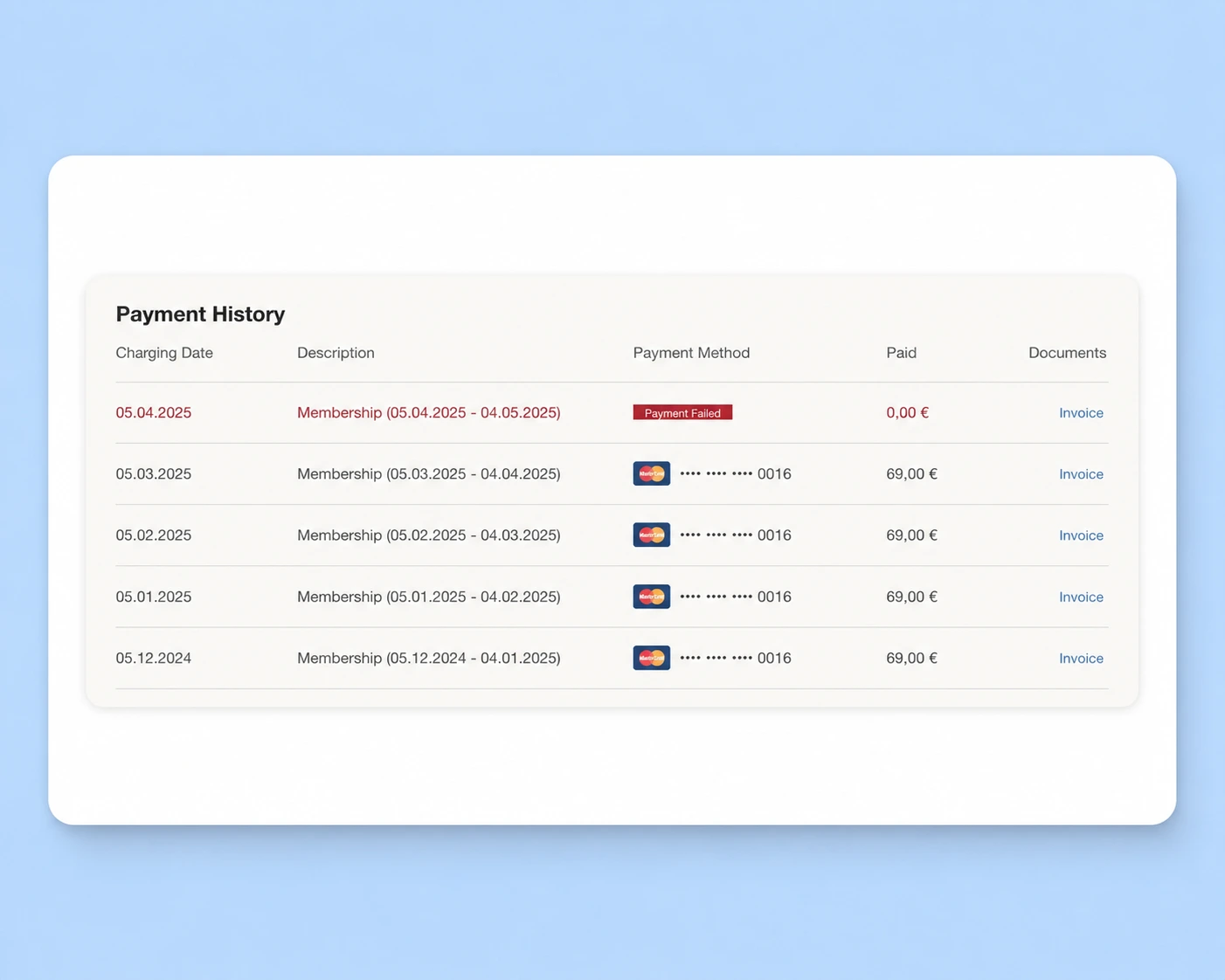
(Old Payment History Page)
TL;DR: KEY RESULTS
- €XXXK+ recovered since launch in May 2026
- 2,284 outstanding payments resolved by members
- 192 support tickets prevented
- 40% reduction in manual bank transfer reconciliation
- 3-day reduction in average reactivation time
The Challenge
For members, an outstanding balance wasn't just a payment issue, it could become the moment they were blocked from using the product entirely. A member could be ready to go to a class, open the app, and find out their account was suspended because a payment had failed in the background weeks earlier. Resolving it could mean making a bank transfer, waiting for a payment retry to go through, or contacting support without knowing exactly when access would be restored.
The experience was unclear on every level: members often didn't know what they owed, why they owed it, or what they were supposed to do next. That uncertainty made people less likely to act - and more likely to churn.
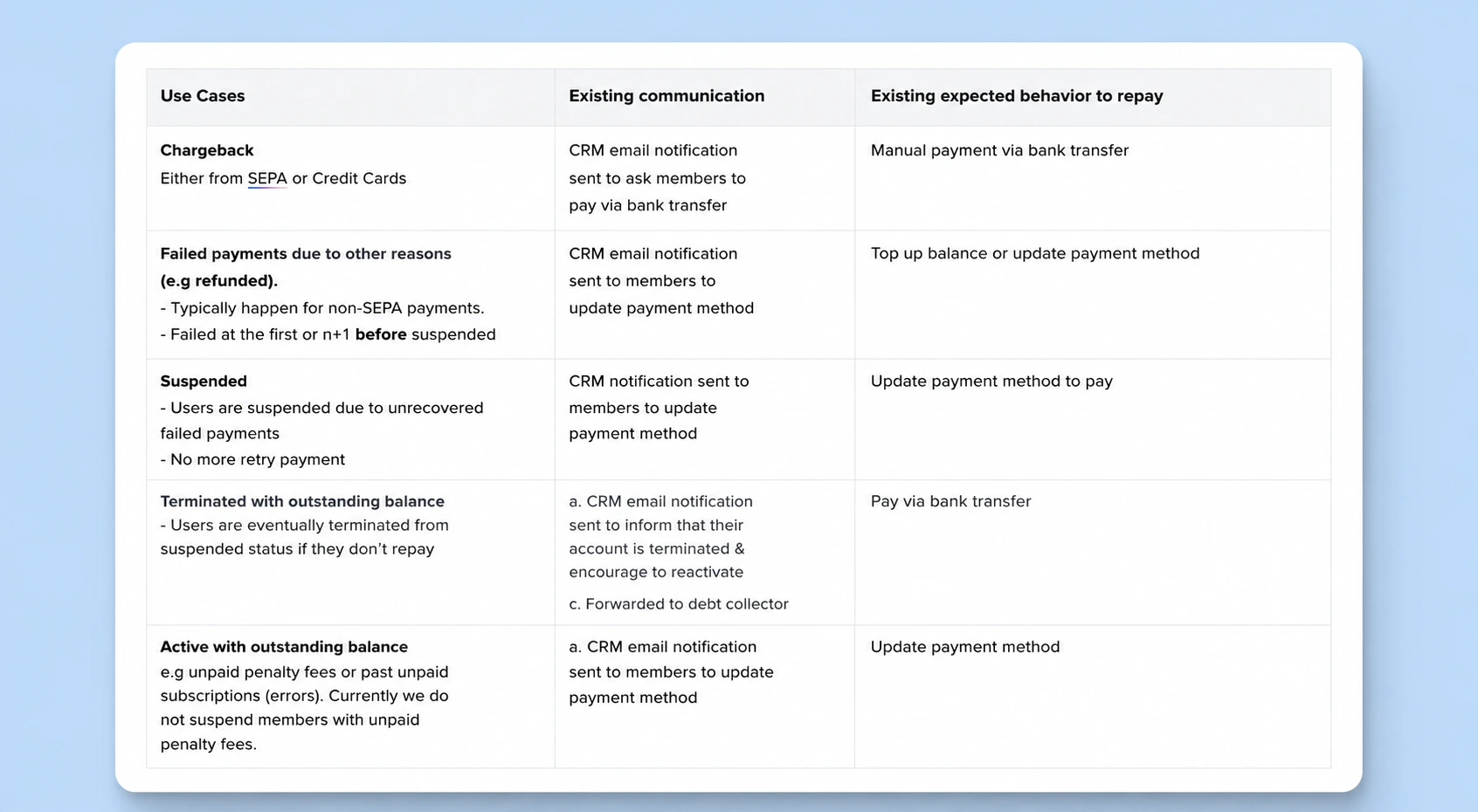
My process started by mapping the different repayment scenarios and identifying what each member needed to understand before they could take action:
- What happened? Why do I have an outstanding payment?
- How much do I owe? What exact amount needs to be paid?
- What can I do next? Can I pay now, or is there another required step?
- What happens after? Will my account be active again? Will the fee be resolved?
These four questions became the design goal: make the outstanding balance visible, explain why payment was needed, and give members a clear and immediate next step.
Pay Now needed to support four distinct scenarios, each with different context and different member expectations:
- Suspended account - the member had unrecovered failed payments and couldn't continue using the product.
- No-show or cancellation fee - the member had an outstanding penalty fee after missing or cancelling a class too late.
- Outstanding membership fee - the member had a failed subscription payment that needed to be settled.
- Terminated account with outstanding balance - the account was terminated due to unpaid balance, but there was still an opportunity to recover the debt.
Each scenario required slightly different messaging and context, but the same underlying need: one clear path to resolution.
Redesigning Payment History
Before building the Pay Now flow itself, the Payment History page needed to be redesigned. The existing page was still part of the monolith, didn't follow Urban Sports Club's design system, and wasn't built to communicate different payment states, outstanding balances, invoices, or recovery actions in any meaningful way.
Rather than building Pay Now on top of a broken foundation, I used the Payment History redesign as the structural layer - the place where members would first encounter their outstanding balance and understand what needed to happen next.
The redesign focused on a few key things.
First, clear payment statuses: members needed to be able to scan the page and immediately understand whether a payment was completed, pending, failed, or required action.
Second, better information hierarchy: dates, descriptions, payment methods, amounts, and statuses needed to be organized in a way that was easy to read at a glance, not buried in a dense table.
Third, invoice access: members could access invoices directly from the transaction list, reducing the need to contact support for documentation.
And fourth, the contextual recovery action: when a payment was eligible for Pay Now, the action appeared directly next to that transaction - so members didn't have to search for what to do, it was already there.
The redesign also aligned the page with reusable design system components, making it more consistent across the product and easier for engineering to maintain going forward.
The Solution
With the redesigned Payment History in place as the entry point, Pay Now became the action that allowed members to resolve outstanding payments completely on their own.
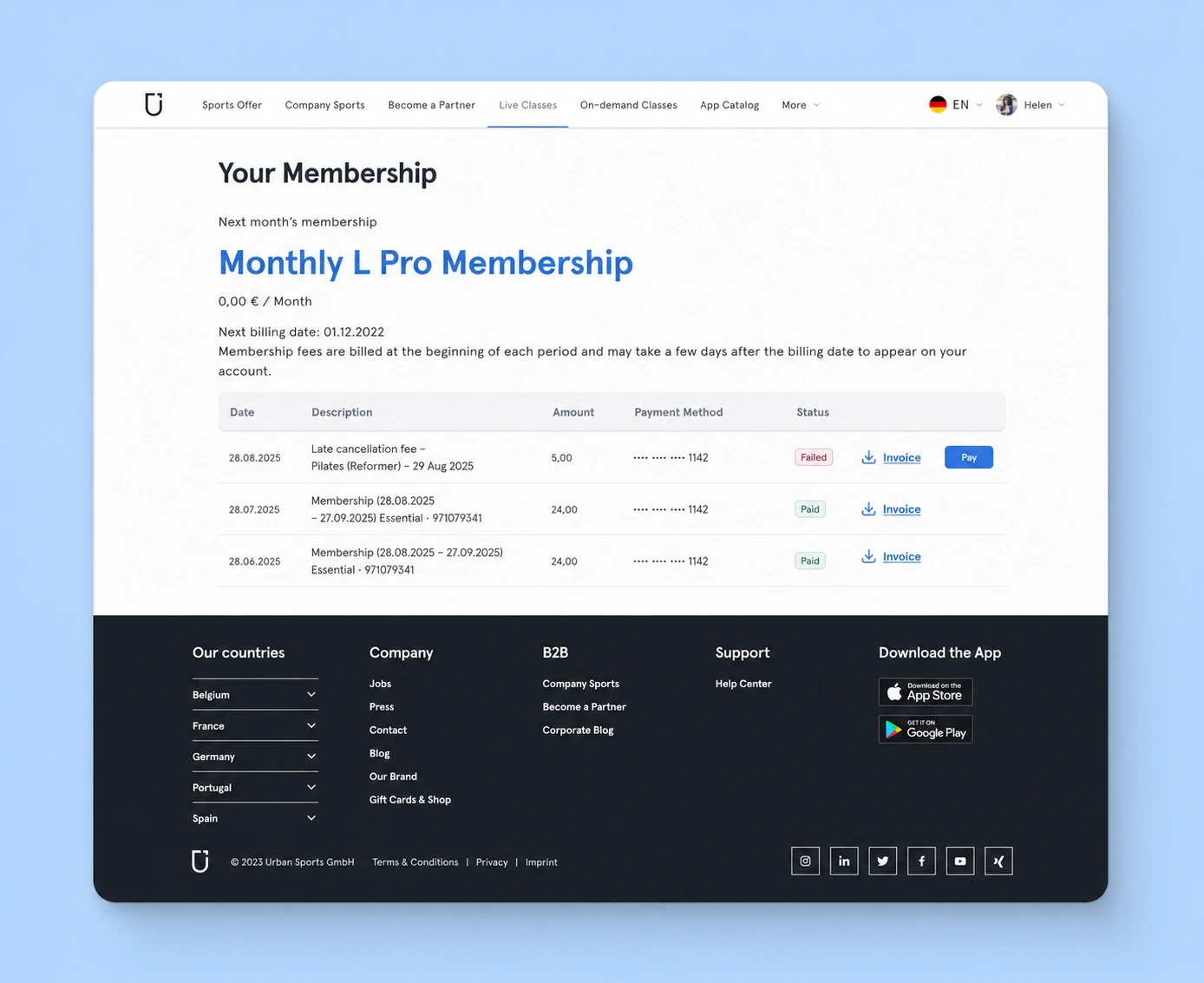
The flow was designed around a simple progression. Members first saw which payment was outstanding, the exact amount due, and the reason for the charge - giving them enough context to feel confident before paying. From there, they could choose an available payment method and complete a one-time payment without any involvement from support or Finance. After payment, they received clear confirmation of what was resolved and a path toward reactivation or continued access, depending on the scenario.